

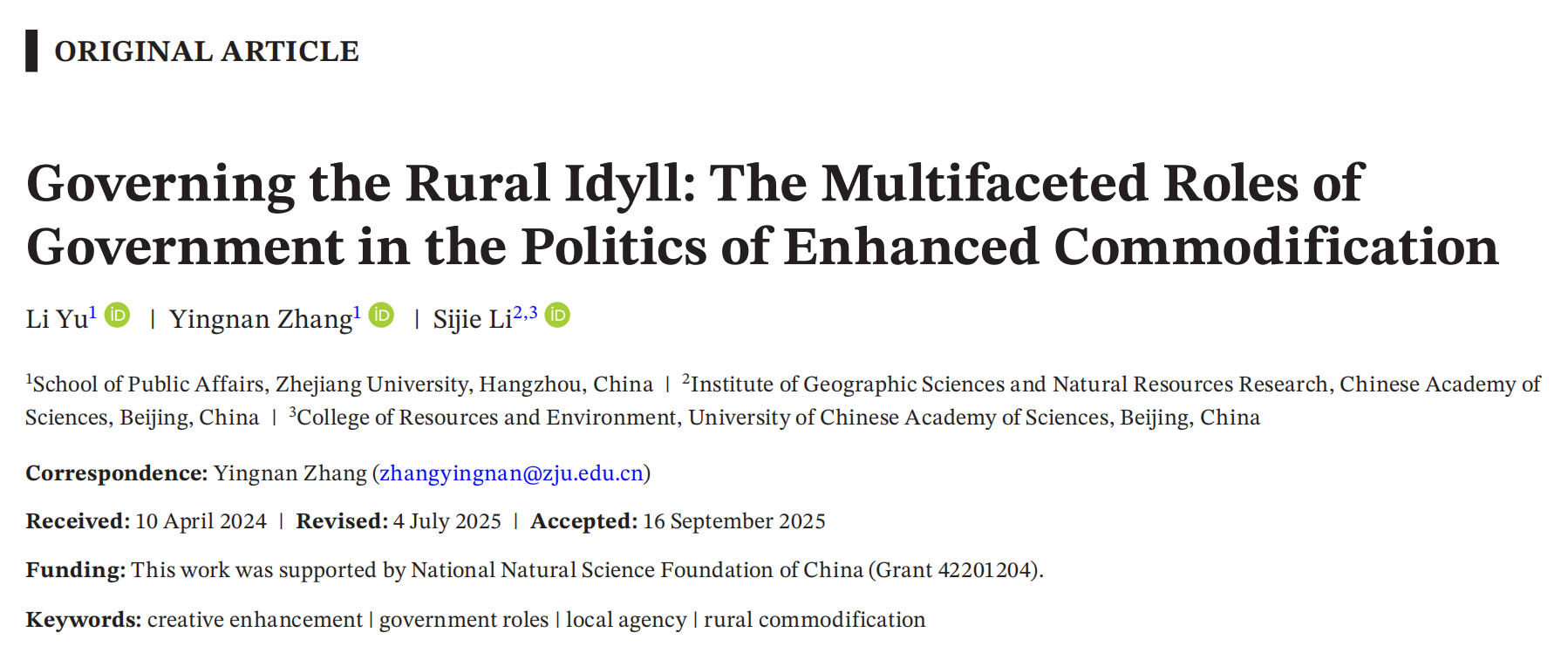
近日,由浙江大学公共管理学院张英男研究员与研究生余黎、李思捷合作完成的论文“Governing the Rural Idyll: The Multifaceted Roles of Government in the Politics of Enhanced Commodification”在美国乡村社会学会主办期刊(季刊)Rural Sociology在线发表。张英男副研究员为本文通讯作者。
该期刊自1936年创办以来,一直是乡村社会学领域的核心学术刊物,致力于发表关于全球范围内乡村人口、社区、环境及相关社会议题的高质量研究成果。作为美国乡村社会学会的官方期刊,Rural Sociology在学界享有很高的声誉,是该领域学者、政策制定者和实践者的重要参考资源。
英文摘要:
This article examines how government intervention shapes tourism-led rural commodification through a dynamic and institutionally embedded process. Drawing on Mitchell’s Creative Enhancement model and fieldwork in Zhoucun—a policy-prioritized village on the rural–urban fringe of eastern coastal China—we conceptualize “enhanced commodification” as a distinct mode that departs from dominant narratives of cultural erosion and displacement. The analysis foregrounds the government’s multifaceted roles as creator, facilitator, and regulator of rural transformation—positions often underemphasized in Western contexts. We identify a three-phase trajectory of government intervention: laying the institutional groundwork for market entry, deploying spatial planning to manage landscape segmentation, and supporting preservationist actors to diffuse governance responsibilities. These interlocking stages have selectively produced commodified rurality while maintaining curated elements of the rural idyll. The findings advance a government-orchestrated and multi-actor interpretation of the Creative Enhancement model, emphasizing how institutional design, grassroots agency, and contingent government-market-society relations condition commodification outcomes. We argue that symbolic cultural practices—beyond material landscapes—play an increasingly critical role under late-capitalist pressures on rural sustainability.
中文摘要:
本研究从动态过程和制度嵌入的视角,剖析了政府干预在旅游主导的乡村商品化进程中的作用与机制。本文以米切尔的“创造性增强”模型为分析框架,并结合在中国东部城郊村庄——周村的田野调查,拓展了“增强型商品化”这一概念,将其界定为有别于主流研究中文化侵蚀与景观替代叙事的独特模式。分析凸显了政府在乡村转型中兼具创造者、推进者与监管者的多重角色——这些定位在西方语境中常被忽视。我们识别出政府干预的三阶段轨迹:通过制度设计奠定市场准入基础,通过空间规划管理景观分离,以及通过下放治理责任支持基层保护主义者。这些相互交织的阶段在维持原汁原味的田园元素的同时,有选择性地催生了商品化的乡村风貌。研究成果拓展了对“创造性增强”模型中政府主导、多主体介入的解读,强调了制度设计、基层能动性及政府-市场-社会关系如何共同塑造商品化结果。我们认为,随着现代商业逻辑对乡村空间的不断渗透,其可持续性面临压力,此时,超越物质景观的象征性文化实践正发挥着日益关键的作用。
原文链接:
https://onlinelibrary.wiley.com/doi/full/10.1111/ruso.70025